Tuesday, January 31, 2017

The Climbers: Photographers Journal

Climber Portrait

Mike Camp – Lake City Ice Park

I've been photographing around for a while now and love shooting most all things...all
subjects. But one stands out with me. You'd think it would be because of the spectacular settings,
the beautiful locations, the challenging approaches, the challenge of finding the right place
to set up, careful not to loose track of my footing. Where I am in relation to rock and
abyss. Careful not to make a mis-step up there in the vertical world where there is no
forgiveness. Where there is a paper-thin line between "all is good" and "all is not good".
Especially when there is the distraction, both physical and mental, of the camera and the shot.

I'm most attracted to photographing this strange sport by the people who are
obsessed by it. They're a unique breed, for sure.

The Climbers

Canon 5DMII w/ 85mm f:1.8


Oh, Really 5.13b

No, thats actually the name Rob Pizem gave to this micro-crack up on Mt. Garfield near my home in Grand Junction, Colorado. It's actually closer to Palisade, which is the grape growing area of our quaint little Western Colorado valley.

Oh, Really is a desert sandstone overhanging finger crack, rated at 5.13b, that ripped a hole in the
back of Robs hand his first time up. We shot this for CAMP USA and it should be appearing in their spring campaign. I've been shooting quite a bit with Piz lately. He understands my ends and needs, as a photographer, and puts me on rock that lights well and has great landscape values.

Canon 5DMIII w/ 24-70 f:2.8


Sarah Watson

Clipping Away 5:10

She is difficult to describe and my words will lack the range of
color needed to tell her story. 

Sarah came to me as a climbing model for an editorial piece I was
doing on Fit Women. Sarah is "on the loose". She resides in and operates out of her car with her dog Charlie, and travels from one group of her friends (and she has many) to another staying a while and moving on. All bracketed by her love of climbing...and base jumping. It's a dangerous enough lifestyle in climbing, then add in jumping off of a perfectly good cliff. Sarah is trained as a biologist, and may go back to that one day, but opts for this way of life right now instead.

I recall the days when if you couldn't fit all your junk into the trunk of your car,
you had too much junk.

My how things change and I envy her. 

Canon 5DMIII w/100-400mm f:4.5  


Pick Detail

To the person I have never met a rock or ice climber that I didn't like. Or more 
accurately, respect. There is a certain calm and self assuredness that runs through them all.
All are self-reliant individuals engaged in an energetic approach to all things.

Whether up there or down here.

Hasselblad 500C w/ 80mm on Tri-X (asa 400)


Code Red Seven 5:13

One totally tough girl is Cecilia , CC, Dembreski. 

In shooting CC on this rose colored slab of granite, I was concentrating on her through the barrel of
my lens more than actually shooting her. I watched as she moved up, a small section at a time, 
working hard with each move. She peeled off the wall a couple of times, falling double the length of her last belay, maybe 12 or 15 feet, only to shake it off and start again. I was totally impressed
with her toughness and determination.

This beautiful rose colored granite is in Unaweep Canyon, south of Grand Junction. 

Canon 5DMIII w/100-400mm f:4.5  


Old man of the Tetons

Al Reed, in his day, was an elite member and guide for EXUM Guides in Teton Park and when
I met him there while on an assignment for Hemispheres Magazine, he was still 
involved with EXUM as their Executive Director, living part time in South America. What a
life. I don't know what Al is up to these days and as this blog post makes it's way around, I hope
others will comment with some news for me. The last time I saw Al, I was up on the side
of Teton Mountain with a climbing group anxiously awaiting some important news from home and
left Wyoming, abruptly, when the news came.

You loose track of people in life, but always remember their essence.

Shot w/ Deardorff V8 (8x10) on Portra NC 160


Climbers Portrait

Craig Blakemore, aka Mad Dog, climbed on the Lake City ice wall for us a couple of years back
and we were able to shoot some unusual set-ups with him because of a huge overhanging
stalactite, or hanging icicle, that formed as part of the wall. Very sheer and precarious, although
it didn't deter him from helping us get our shot. One of the shots below illustrates this nicely.

Canon 5DMII 


Jeffrey is grown now, but it seems like yesterday we were out shooting this. These kids grow           up so fast. Climbing and bouldering is such a great way for a father and son to bond. For Dad           to show his son "the ropes". 

I shot this photo on Portra NC 160, on a tripod with an old Speed Graphic Pacemaker and
a retrofitted rectilinear barrel lens. The old barrel lenses have no shutter mechanism so you need
a camera with a rear "curtain' shutter. I have not shot with these cameras for some time, but
am about to reintroduce them to my quiver of equipment one day soon.

I love the way the old leather and wood smells and the clunky sounds they make.


The Designator is a well known ice fall in East Vail forming off the north side of the East Vail
Chutes. I, at the time this was shot, lived in a little log cabin directly across from the "Des" and,
in the summer months, could lay on my bed and watch the falls. It was so pacifying and 
relaxing to watch the water make its plunge to the valley floor below. Almost in slow motion.

On this day, and many others, I was shooting with Jim Nowak, who was my favored ice 
climber of that time. Jim was a great and trustworthy climbing model and I always knew he would be safe. I have some photos, buried somewhere, of Jim free soloing on the Designator. He was that
confident.

Jim has moved on, although I run into him from time to time and he has since founded
the DZi Foundation www.dzi.org, who's efforts move teen aged girls in Nepal out
of a life of prostitution and into the safety of safe houses giving them the opportunity to attend school and better their lives. 

I'm so proud to call Jim a friend. 
  
Fuji 617 w/ 90mm Fujinon SW on Fuji Velvia.


Escalante Canyon

 On the shoot in the image below this one, Crawford was our belayer. Super important job. When
we wrapped, he wanted to finish off a route that was situated directly above "Milk is for Babies".

It was a bonus for me because it allowed me to show more of the beautiful canyon we were in
so I positioned myself for a landscape with Crawford small in the frame to show scale. The
shadow was moving up in the waning part of this November day so we lucked out and caught
the last little bit of sunlight on the sandstone slab.

The red fleece didn't hurt either.


Escalante Canyon

My friend Rob Pizem, or "Piz" as most know him, is a well known rated an sponsored climber
here in Colorado. When he has a pitch he is trying to put up he'll call and invite me out for some
photos. Piz understands my needs as a photographer as they relate to sun angle and composition
so it's fun to work with him and have him as a resource. 

A window in, so to speak.

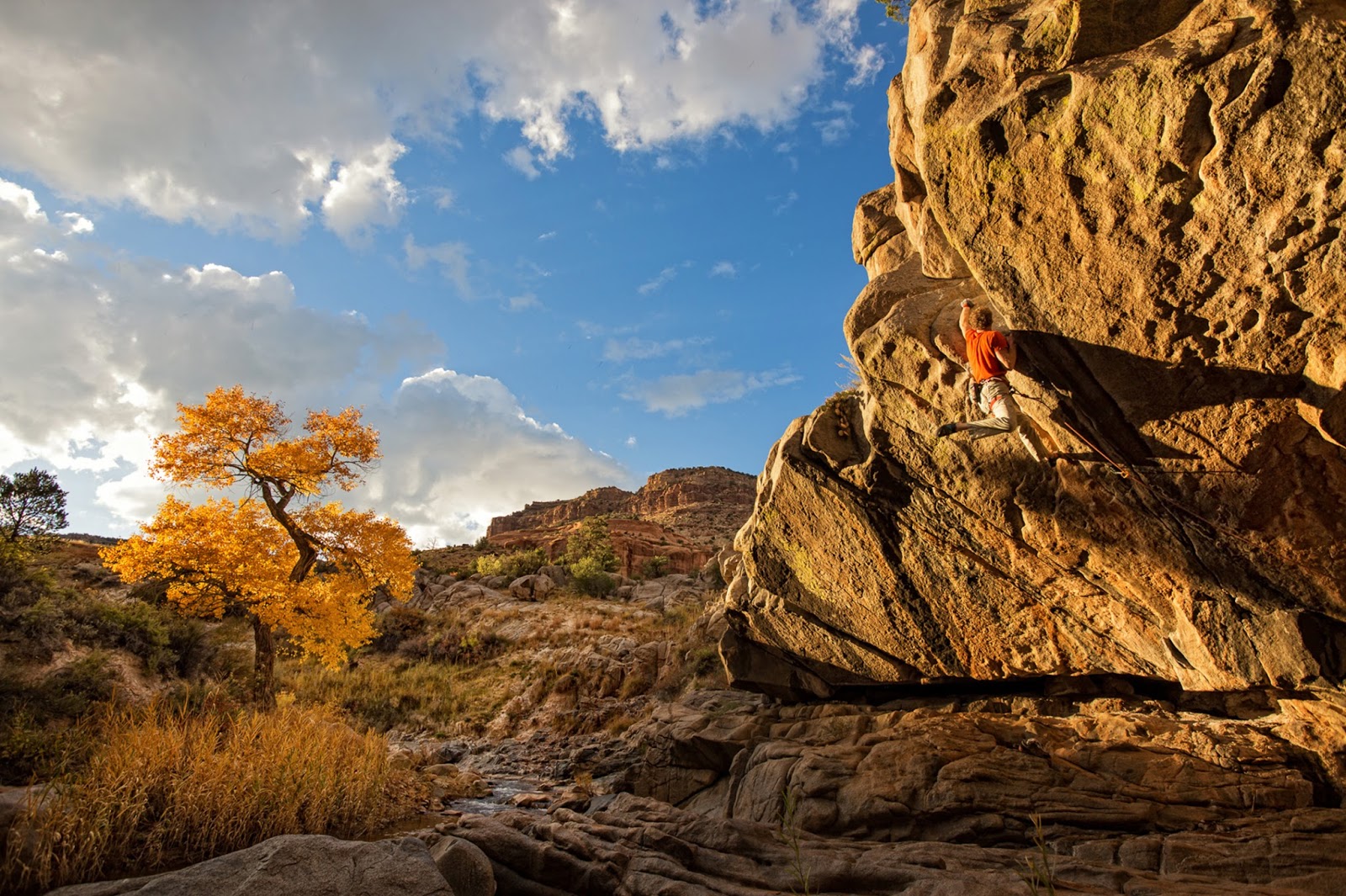
"Milk is for Babies" so named by Piz himself, is a sandstone overhanging crack that Piz had been working on. A fingersplitting micro-crack. Once he had it at a certain point, I came out to shoot. We waited until the cottonwood at left was on fire wanting that to be part of the story. Rob was up and down this route several times, usually peeling off and falling on his belay. 

Painful to watch !

Canon 5DMIII w/ 24-70mm 1:2.8 II USM

I hadn't heard that Lake City had it's own ice park until my friend and assistant, Rob Reece, https://www.robbreecephotography.com, took me down there and introduced me to Mad Dog
and Mike Camp.

I have always love the pure cold and warm tones created by granite and ice.

Canon 5DMIII w/ 85mm f:2.8


The look on Piz's face coiling his rope after rapping this pitch in the brisk evening air tells the      story of the satisfaction and peace we all feel when we've completed a challenging task.

From a photographic perspective, I did not set this up. I anticipated the shot while kneeling
down to switch lenses. I swung my camera up and used CC as a nice, soft foreground 
element. A body part. Nothing glamorous, just a sweet moment of peace.

Canon 5DMIII w/ 24-70mm f:2.8


Memories fade over time.

Over the years I've had chance meetings with people of all sorts. With that sometimes comes
an opportunity to photograph something different, or from a different perspective. 

I wish I had been a better record keeper because as I have gotten a little further down the line
I find that I hate not knowing or beagle to recall the names of the people I have shot
with. When I look back upon a photograph I am able to conjure up an entire event that I
have not thought about in a decade. Time goes by so fast.

I do remember meeting this chap and recall thinking how small and skinny he was.

Didn't stay that way for long. 

As soon as he got up the rock I could see how his lithe proportions lent themselves to
getting up the rock.

Canon EOS-1 w/ 14mm f:2.8

Kodak Tri-X


Blowing' and Goin' 5.12

The action of rock climbing is subtle and refined. Not like that of cycle racing or skiing, but
it's there none the less. The great climbing photographers have refined their craft into an
art form utilizing the the landscape and human form to capture this otherwise nonsensical struggle
of man against the immovable force of stone.

Q: Why do you climb ?  A: Because it's there !

As I shoot this sport I am always aware of the moment, or the instant that the action is occuring
through the tunnel of my lens. There are times to shoot and times not to. A time when the static becomes fluid motion...only for an instant.

The use of shadow and high-light, foreground obstruction creating a composition in thirds, looking
down into the face of my subject as he fees rope through his teeth and reaches up to place new
protection.

The Starling flying below didn't hurt the image either.

Canon 5DMIII w/ 100-400mm f:4.5 L Ultrasonic


Perfect Knots

There is only entropy in the sport of climbing.

Order within the lack of order. Equipment must be reliable, knots correct, but equipment and 
flesh are in a state of continuous abuse...hands, ropes, hardware, but hands especially. 

I have a very large print of this image in my office and it is one of my favorite images.

Reminds me not to stray from an arduous task.

Speed Graphic Pacemaker with a retrofitted rectilinear barrel lens circa @ 1880-1900
Portra NC 160


Ouray Ice Park Portrait.

Kim Reynolds was gracious and kind to let me shoot her at Ouray, Everyone knows about
the ice at Ouray. We did a few different things that day and one of our shots even ended up on
the Marmot Catalog.

But this was my favorite of that day.

Graflex Speed Graphic Pacemaker w/ Graflex Optar 135mm f:4.7 (slight tilt)
Polaroid Type 55 P/N (scanned negative) 


Cramp-ons

Details within the act and again the testament to a sport reliant of dependable gear. Expensive
gear.

This image also hangs on a wall in my office above the end of my desk. It contains such detail that
the viewer is drawn into the image deeper and deeper, the longer they look at it.

Canon 5DMII w/ 16-35 mm f:2.8 L


 Peter Lev

Peter is retired. I ran into him on Jackson Hole Mountain one summer day while attending a climbing
guide orientation for EXUM Mountain Guides. Peter was 72 at the time and I was interested in
guys like him who had had a rich past and were still putting younger men to shame. Lev had
guided for EXUM in past years and was a Co-Partner at Exum still.

When I run into dynamic people like Peter Lev I have trained myself to reach out with questions 
to shoot a portrait if I have a camera with me. This has allowed me to meet some interesting
people and to learn a bit about them. This, I feel, is one of the rich bi-products of being blessed
as a photographer.

This portrait of Peter remains one of my favorites to this day.

Canon 5D w/ 16-35mm f:2.8 L


Lake City Ice Wall, Colorado

This image is one of my favorites, I guess because of the clouds that rolled in and the fact that
this ice had formed free of the main wall creating an additional dimension. Ice forms where water
flows, sometimes emerging right out of a piece of rock where there is a seep in spring and 
summer.

Mad Dog knew his ice, otherwise I wouldn't have allowed him to be up there for photos.

Warren Miller once said that a ski models i.q. decreased by 70 points when there was
a camera around.

Applies to all.

Canon 5DMII w/ 16-35 mm f:2.8 L


Wednesday, January 4, 2017

Oshkosh - or the Addiction with Getting High in Wisconsin

Matt Lander: Wonderful Machine

Taking a flight used to be an experience. Women wore dresses and men wore suits. Unfortunately for us, the seats seem to keep getting smaller, the prices keep going up, and the class and comfort that used to go along with flying have disappeared with our complimentary peanuts. Thankfully, there are those at EAA AirVenture who are keeping the excitement in flying through the Oshkosh Airshow. Colorado photographer Ken Redding recently got to capture the art and style of it all.


Every summer for more than 60 years, EAA AirVenture has invited aviation enthusiasts to gather and marvel at the accomplishment of human flight. In July of this year, over 10,000 aircraft were on display in Oshkosh, Wisconsin. Ken is constantly in search of interesting and inspiring material to add to his portfolio, so when a pilot friend encouraged him to attend the show he knew it would be a great opportunity to create some exceptional shots.


Never having shot planes before, Ken relied on his experience as an automotive photographer to help plan the production of his shoot. Shooting a large event like the airshow left very little control in Ken’s hands. “We had to make sure we caught some early and late light and understood the daily schedule so we were in place and ready,” says Ken, planning as much of the shoot as he could.


During the shoot, Ken had to battle the mid-summer heat and humidity of the cheese state. “Once the sun was up we were wringing wet,” he says. “It was hard to stay hydrated.” Despite the blanket of moisture in the air, the blazing sun, and the fact that they were walking around on a cement tarmac for most of the day, Ken captured some amazing images. He used his background in shooting fast-paced sports like cycle racing and skiing to his advantage when shooting the aerial maneuvers of the stunt pilots.


In addition to capturing the exciting movements of the air planes, Ken was also careful to get some still shots of the structures themselves, gracefully reminding us that the machines are functional pieces of art, made of polished steel, hand crafted wood, and glossy paint jobs.


The freedom of a self-assigned project allowed Ken to pick and choose what he wanted to shoot, and the results left him with a great collection of shots that he is posting on his blog and cycling through promotional materials. His experience at Oshkosh has inspired him to try some air-to-air shooting and he has received an offer to do just that. The Wright brothers would be proud. 


Friday, July 22, 2016

REMEMBRANCE


Countless times I have been commissioned to photograph a piece or tract of land that
has not changed in a hundred years. Almost always, if not always, there are ruined buildings
and structures that are slowly being consumed by the land I am photographing. I have
cautiously entered most of these once inhabited places and, as a visual recorder, am enthralled
by the eroding patinas and textures that create almost a mosaic of patterns and colors, always
making for a great abstract bonanza. I always wonder and think about the lives that once
existed in these places. The voices and conversations that once filled these spaces.

On a very recent trip to the Panhandle of Texas, my wife drove me out to a farmhouse where
she had spent the first 10 years of her life, at a time when her Dad farmed the surrounding
section or so of land.

We walked through this old farmhouse together, watching carefully where we stepped and I 
observed closely as Camille's expressions changed. She told me about some of her 
remembrances, but only she knew what was flooding back to her.

Below are some of the thoughts as recollected by her --


          In July of 2016, Ken and I traveled to Tulia, Texas so that I could work on some estate-related tasks. My parents' estates are still being finalized and my uncle's estate needed attention, too.  One of my goals for this trip was to see some new power transmission lines that have been erected recently along the boundaries of two farmland parcels I have inherited. Ken agreed to drive to the country with me. What began as a simple little excursion to inspect some transmission lines ended up being an emotional journey and an unexpectedly vivid reconnection to my past. 
          I lived on that farm from the time I was six months old until I was ten. The land was owned by my grandfather Roy McCasland, a dentist in Tulia who named his farm "Tooth Acres". PawPaw, as we called him, was raised on farms and owned at least one as long as I knew him. Agriculture was in his blood. It was in my father's blood, too. In every branch of my family, there is a long history of farming and ranching. My dad, John Simpson, or Big John, as he was known throughout the county, had begun farming in the area after graduating from Texas Tech University with a degree in agriculture/animal husbandry. He had fought in the South Pacific during World War II and, like many other farmers in his generation, had gone to college on the GI Bill. Soon after marrying my mother, Daddy went into business with his father-in-law and began farming "Tooth Acres". We moved into the little house on that farm in 1956 and became a family of four when my sister was born in 1959. Abundant irrigation water and ideal growing conditions meant high yielding crops of milo (grain sorghum), cotton, and wheat. Daddy raised cattle and hogs, too. Farmers had to work from daybreak to sundown, and be willing to take risks with debt and weather. It was a good life. My dad always said he loved farming because he was meant to be an "outside guy". My love of the outdoors surely must have been inherited from him. 
          When I first viewed Ken's photos from our afternoon at the farm, I wasn't sure I wanted him to put them on his blog. I felt strangely private about my encounters that day and also a little hesitant to show the farm's state of disrepair. However, being inside the house and in the landscape released such a powerful flood of memories, I decided they should be shared. Even though Ken's photographs speak for themselves and certainly do not require my lengthy memoir-style sketches, I hope someone who reads them can get a small glimpse of my young life at "Tooth Acres". My reflections appear underneath each scene.


          Ken entered the house before I did. I hesitated because I wasn't sure how stable the floor was, but since Ken had already walked through this room, he coaxed me to come inside and watch where I stepped. For the first time in decades, I walked through that door and gingerly picked my way across the decrepit floor. This door led from the driveway slab where my parents parked our family car and was the entrance we used most of the time. We seldom entered through the front door; that was for company.
          I was astonished at the condition of the house. I had taken Ken and our daughters to the farm a few years back, but we had just peered into the house without going inside. It was in terrible condition then, but had deteriorated even more since. The old floors from my childhood had been replaced with new vinyl and carpeting back in the seventies when Silverio, my dad's hired hand during those years, had occupied the house with his family. Even so, it was a mess to behold. The subfloor was visible and rotting in places. The ceiling had collapsed in some rooms, and I could see daylight through the rafters. Windows were shattered or missing; broken cabinet fronts and drawers were lying on the floor. It was impossible to tell whether the house had been vandalized in the past or simply had been beaten by decades of exposure to the brutal elements of West Texas. It seemed small inside. The house had never been good-looking or special, but a very modest home even in the fifties. My parents gave it as much style and warmth as they could, and being within its walls these many years later evoked myriad memories of my childhood, both pleasant and bittersweet. 
          Our dining table where we ate every meal was placed against the wall on the right. On occasion, it served as a conference table for my dad and farmworkers to discuss jobs and seasonal work. I remember Daddy meeting at that table with Mexicans who didn't speak English, a black man named Preacher, and the patriarchs of migrant laborer families. Earl Davis, my dad's long-time lead hired hand, would sit with my dad at that table, drinking coffee and smoking cigarettes. My parents didn't smoke, but they never asked a guest to smoke outside. Attitudes were different back then. I would watch as Earl deftly rolled his own cigarettes. He would open a pocket-sized tin or sometimes a muslin pouch filled with smoking tobacco. He then would pull a rolling paper from its packet and hold the edge of it, making a trough with his forefinger. With the other hand, he would pour the brown leafy substance in a line the length of the white paper, somewhat mounded in the center. With skilled precision, he would roll the tobacco in the paper between his thumbs and fingers and lick the outer edge to secure it. He would snap the lid of the tin closed or, if using a pouch, would pull on the gold drawstring with his teeth. Then he would light the neat little cigarette and smoke it down to a short butt, making gray smoke clouds that swirled around in the shafts of morning sunlight streaming in from that side door. These visits between Earl and my dad must have occurred during winter when the farm workload was lighter. Summers were too busy from dawn to dusk for lingering over coffee.
          I remember when we got our first black and white TV. It stood in the upper right corner of the photo and we would watch it seated in chairs that were under the windows. Suzanne and I watched "Captain Kangaroo", "Superman", "Mighty Mouse", "Our Gang", "Lassie", "Lost in Space", and "I Dream of Jeannie". I watched "Friday Night Fights" with Daddy. He didn't have a son, and it seemed normal to me that we did that together. As a family, we sat in that room and watched Jack Benny, Perry Como, Ed Sullivan, and Dinah Shore. In 1964, we all watched The Beatles perform live for the first time in America on The Ed Sullivan Show. I remember thinking the screaming girls were silly and annoying.  
          We moved to town when I was ten. My mother had taken a teaching job for the first time since she had become a mother. Daddy moved our entire household one day during the first week of school that year. I remember our last supper meal in the farmhouse was on August 30, 1966, my tenth birthday. My parents' gift to me was a dainty Timex wristwatch with a black suede band. After that, Suzanne and I were "town kids".


           As I gazed out the trio of windows from what once was the family room/dining area, a slideshow of the past ran through my mind. Visible through the window to my left is the old iron T from which were strung three wire clotheslines my mother used during the warm months. Hanging laundry could be risky since wasps liked to make nests in the hollow horizontal tubing of those Ts. I visualized white bedsheets flapping in the ceaseless wind and remembered what it sounded like when they snapped in the gusts. I always thought sheets fresh off the line smell like air and sunshine. 
          The same window held the swamp cooler. My younger sister Suzanne and I loved to climb backward into the big chair underneath it and talk into the cool rushing air, our little voices distorted by the rhythm of the fan. We would laugh and do it over and over, thinking we sounded like robots or aliens (we called them "space people"). 
          Since this bank of windows was north-facing, my dad could monitor approaching thunderstorms and "northers" from inside the house. A set of west-facing windows in the big laundry room provided another prime vantage point for viewing weather coming from that direction. As anyone from a farming background knows, keeping a vigilant eye on the weather becomes habit. Weather could bring the blessing of much-needed moisture or it could bring disaster to a farmer's livelihood in a matter of moments. Many times after dark, my dad would stand with his elbows on the window sills, watching lightning in the distance and wondering if welcome rain or dreaded hail were on its way. 
          Sometimes a spring storm would bring the most feared phenomenon of all (at least to a young kid): a tornado. Looking out the window, I could see the place where the old earthen storm cellar had been. I suppose it is still there; the grass has grown over that entire area, making it difficult to see some old features. I began to reminisce about a particular afternoon in the spring of 1965, when that cellar sheltered our family and the hired man and his wife, Mr. and Mrs. Davis, during a storm that spawned a tornado. It was the first tornado I had seen up close, and the experience is etched indelibly in my mind. The pristine white funnel descended tentatively from a dark cloud, bounced on the ground, then turned dark brown as it churned dirt. Gathered around the cellar entrance, we watched as long as we dared. I remember feeling caught in a dilemma: being terrified to descend the rickety wooden stairs into the dank depths of that cellar, but even more terrified to stay above ground any longer. After we emerged unscathed at dusk, we called around on our party line telephone and found out that the tornado had destroyed some outbuildings and silos at a nearby farm, but injured no one. The old black rotary-dial telephone was kept under the middle window on a wooden telephone table. Last week, I found that table in the concrete storm shelter of the house in "town" that my sister and I inherited from our parents.


          This is a view into the kitchen with some of the living room visible on the left and the laundry room straight ahead at the rear. The old gas stove on the wall to the left was the heat source for the main living area. I remember standing close to it and getting my hair singed!


          Could this possibly be the same tidy kitchen where my sweet mother prepared every meal from scratch? The refrigerator was on the left before the green pantry door and the range was straight ahead against the back wall. On hot summer afternoons, I remember making Fizzies at the peninsula on the right. My mother, Helen, was known to be a great cook. We grew up eating homemade biscuits, pies, cakes, cookies, canned fruit, pickles, jams, jellies, and preserves. I remember licking the beaters and bowls when she made something sweet. We have photos of my little sister, Suzanne, sitting beside the pink strawberry cake our mother made for her second birthday. To this day, that is my sister's favorite cake. My own daughters request that I make it for their birthdays, too.
          Mother could cut up a whole chicken in a just few minutes. Women learned that skill back then. Fried chicken was my favorite meal. I was not a meat lover as a child, but I did love her fried chicken and gravy. The first time I ever ate fresh asparagus was in this house. If people in the fifties and early sixties ate asparagus, it probably came in a can. I hated anything made with canned asparagus and would refuse to eat it. Then, Mother served fresh asparagus one day and I did not recognize the vegetable at all. I've liked it ever since! 
          My mother was not your typical farm wife. The daughter of a dentist, Helen Rose McCasland  grew up in Tulia, our little town, and graduated from college. She was beautiful (but never thought of herself in that way) and had fine clothes. She was refined and appreciated the arts. She had a lovely mezzo-soprano voice and sang in the church choir; she was requested to sing solos in countless weddings, funerals, and special events nearly her entire life.  She had been a schoolteacher before I was born. As Ken and I drove away from the farm that evening, I recounted to him how challenging farm life really was for women like my mother. As a child, I liked the open spaces and freedom, but it wasn't so easy for mothers. We lived on dirt roads 17 miles from town. All our conveniences, social gatherings, and church activities were in Tulia. Mother drove to and from town several times a week. Mother once told Ken that whenever she got stuck in the mud during a downpour, she would just wait patiently, sometimes falling asleep, because she knew that Daddy would soon show up in his pickup or tractor to pull her car out. 
          The water source for the Texas Panhandle is the Ogallala Aquifer, a vast underground reservoir that lies underneath the Great Plains. Our crop irrigation wells and our domestic water well tapped that aquifer, producing water that was usually clear, but sometimes had red sand in it. I remember taking more than a few baths in brownish water while sitting on top of a gritty layer of sand that had settled to the bottom of the tub. Women had to wash clothes in that water and cook with it. We drank it. There was always dirt blowing in the window sills, too. Even though Mother vacuumed and dusted frequently, it was nearly impossible to stay ahead of the dirt. That's what it was, too. It was field dirt, not dust. Every so often, she waxed and buffed the linoleum floors. Farms had wasps, bees, varmints, bad smells, mud, and cesspools. Then there was the isolation. Fortunately for all of us, we had many friends and family who lived in town. After my mother passed away, Daddy said that she never complained, but was always sweet and happy. I'm glad he thought that. It's how I remember it, too. 


          This is a hallway leading from the back of the kitchen to the laundry room on the west side of the house. My dad had a chest of drawers against the wall on the right where he kept his work clothes. He sent his khaki pants and shirts to Mrs. Carter's steam laundry in town. I think he grew accustomed to doing that when he was a bachelor farmer. He said his work clothes were so dirty he didn't want my mother to have to wash them. The clothes would come back from the laundry neatly pressed and folded, tied in bundles with string.
          On the left was the bathroom. Inside the bathroom were storage cabinets and the hot water heater. When I was in first through fourth grades, my mother drove me to meet the school bus at 7:00 a.m. The farm was located in the Kress school district, but my parents had decided to pay tuition and transfer me to Tulia schools where my friends and family were. On cold winter mornings, Mother would wake me before dawn. The main part of the house was so cold, Mother would seat me on the edge of the bathtub where it was nice and warm. That's where I would eat breakfast until it warmed up in late winter.


          On hot summer evenings, we would leave that side door open; Panhandle evenings are nice and cool. I remember the sound of June bugs buzzing and bumping into the door screen, attracted to the light inside the room. In my imagination, I can still hear the humming of irrigation well motors, near and far, running through the night. Many irrigation pumps were run by converted truck engines and they didn't have mufflers. Over the decades, the Ogallala Aquifer has depleted gradually. Wells need to be much deeper now to reach good water. Now farmers must raise crops using much less water or simply raise dryland crops. A farmer friend recently told me that our dads used up all the water, pumping it on their crops as if the supply would never run dry.
          Our dog Ringo would look longingly at us from outside this door. He was allowed inside on very cold days only. He had a dog house right outside that door. He was a red and white border collie that had been a surprise gift from Daddy. We loved him. Boredom and lack of a job are probably what got him into trouble. Mrs. Davis really didn't like the fact that he would kill one of her chickens here and there. He chased cars and ended up with a broken rear leg when a pickup ran over it; it was never set by a vet and became fairly useless. However, it didn't seem to bother Ringo or slow him down at all. I don't believe my parents understood that he was intelligent and needed more training, more attention, and more of the things we commonly give our pets today. When we moved to town in 1966, we didn't have a fenced yard at our new house so Ringo stayed at the farm where Daddy could feed him and check on him every day. Some time later, Daddy told us Ringo had run off. It wasn't until I was middle-aged that I learned the truth. Ringo had gone to a neighboring farm and was shot. He probably had become a nuisance, possibly killing some chickens, but I do not know. Daddy couldn't bear to tell us all those years. I wish I could have done it differently . . . but I was only ten. 


          This was our living room. The front door is gone. We had nice furniture and an area rug on top of wood floors. The bedroom belonging to my sister and me is through the doorway to the left; my parents' bedroom was on the right (not visible). I was four or five when Santa Claus knocked on that front door on Christmas Eve. He brought a new red tricycle for Suzanne and a little red, white, and blue bicycle with training wheels for me. It was a very exciting Christmas, indeed. I think I had trouble falling asleep that night. As it turns out, Santa Claus was my grandfather, Dr. McCasland, or PawPaw, as we called him. For many years, he played Santa Claus for countless community and church events in Swisher County. He was the perfect Santa, too, so much so that I didn't recognize him under the white beard and red suit trimmed with real fur until I was in second grade. When I told him after a church Christmas party, "PawPaw, Santa Claus sure did look an awful lot like you tonight," he said he would tell me a secret if I promised not to tell my mother, my sister, or my cousins. He gently revealed everything about the legend and his portrayal of Santa. He urged me to still believe in the magic of Christmas and Santa Claus. I was only seven, but I took the information well because it had come from the jolly old elf himself! And I tried hard to keep our secret.


          Before we drove away, I asked Ken to take one more photo of me at the farm. This is right outside our old house looking north. The old storm cellar is up the road on the left and the Quonset barn is in the distance. The well house is the little stucco building on the right next to the power pole. Up the road on the left is the home where Mr. and Mrs. Davis lived. It, too, is in ruins. When I was a child, I was told that a couple of the houses had been army barracks before being moved to the farm. I think theirs was one.
          The Davis's house was humble, but it was filled with love and laughter. Earl was a crusty old fellow, good to the core. He teased and joked with my sister and me and tickled us if he wasn't too tired. I remember many evenings after he came home from working, he would lie on the floor of their living room in front of the TV, so exhausted he couldn't move. Suzanne and I spent a lot of time at the Davis house. Mrs. Davis called herself, simply, "Davis". My mother preferred to call her Mrs. Davis; we kids called her both. She was an older woman, or maybe she seemed older because she had endured a lifetime of hard work. The mother of five children, she was a loving, generous, God-fearing woman who had been raised in Arkansas. Sometimes Davis spoke with yearning about her young days in Arkansas. My mother wondered how she could tolerate the dry barren plains after growing up in the lush environs of Arkansas. She was a second mother to my sister and me. At the end of a summer day, Suzanne and I might find her sitting on the wooden steps leading to her front door. She would rest her elbows on her knees and exclaim in her Arkansas drawl that she was "tored", and we could see it was true. She might take off her shoes to reveal blistered feet or show us blistered hands that had worked a hoe all day. Davis and her daughters sometimes earned a little extra money by "chopping cotton" (hoeing weeds by hand in the cotton fields). To shield their delicate skin from the sun, they would wear Levis and long-sleeved shirts with old-fashioned bonnets Davis had sewn. We would sit with her and beg her to do the trick with her teeth and after a few moments, she would summon the energy to oblige us. With her tongue, Davis would flick her false teeth out of sight to the back of her mouth and give a big affected grin, revealing bare gums and no trace of her dentures. Then, with a sudden clack, she would thrust them forward to the outside of her lips, making her face look delightfully cartoonish. In an instant, she would flick them back into place again. We laughed and laughed. I still miss her.
          Earl and Davis had three grown boys who no longer lived with them. It was always a happy day when they came to visit. Their two younger children, Rita and Darlene, were quite a few years older than Suzanne and me, but they were our joy and delight, our only playmates much of the time. They were sweet to us and played so patiently with us, making mud pies and indulging us in our little girl games. As they grew older, they let us play in their makeup and hair curlers. We spent eternal afternoons waiting for Rita and Darlene to walk up the road after their school bus had dropped them off. When we were very young, I remember their long full skirts worn with bobby socks and saddle oxfords. They grew up, and everything changed when Rita got a boyfriend.
          The day Earl and Davis moved away was one of the coldest January days I can remember. It was also one of the saddest. Suzanne and I hovered around the family as they loaded furniture and boxes on a truck. The front door to their house was wide open and there was no escape from the wind and stinging cold. Earl was getting older and years of farm work had taken a toll on his body. He had taken a good-paying job at a grain elevator in nearby Happy, Texas, and the family had found a lovely turn-of-the-century brick home there. Happy is only 16 miles north of Tulia, and we were somewhat comforted by the adults' reassurances that we would see one another frequently. My dad was happy for Earl, but knew it would be hard to replace him on the farm. No one would ever replace them in our hearts. I held back tears as bravely as possible until we watched the moving truck fade out of sight. Then I'm sure I cried a long time.
          From time to time, there were other families who lived on the farm. For several years, the Talamantes family lived in an old house that is no longer standing. Their younger children were close to our ages and, naturally, they became our playmates. I loved eating their mama's homemade flour tortillas. For a couple of years when our three families lived on the farm at the same time, it was quite a lively place.
          Ken and I accomplished our mission, and more. The transmission lines look like I thought they would: heavy wires suspended from tall brown steel structures. The surrounding area is criss-crossed with new transmission lines just like them. Some people speculate that wind power is coming. I never fully believed the utility company representative who negotiated with us on the lease when he said the reason for the transmission lines is to improve service for the rural customers. No one is moving to these farms.
          I was happy to see that many farms in the area, unlike ours, are still in cultivation. The cotton fields looked very healthy. Our farm is in a popular government program called the Conservation Reserve Program, or CRP. After my dad stopped farming in 1985, native grass was planted in accordance with CRP requirements. The purpose is to mitigate soil erosion, enhance wetlands, and preserve native habitat. As one can see in the last photo, grass has covered the road and all the other areas where people once worked, drove, and played. Thriving fields of wheat, cotton, and milo once grew all around where I am standing. Cattle grazed in the field to the right. Shiny new tractors and combines were parked near the barn.
          My parents are gone and my beloved Uncle Roy Allen, who had no children, passed away last November. I now co-own the 630 acres with my sister and my aunt. One day my cousin Steve will inherit Aunt Dorothy's share. After that, our children might co-own it together. I wonder what is in store for this wondrous piece of earth. Will it remain in CRP grass, looking much as it did when Coronado first explored the area?  Will it ever be in production again? Will wind turbines stand tall, spinning in the West Texas wind as they generate electricity? Will we decide to sell it? For now, I'm glad to hold onto it, but in any case, I am grateful for rich memories of a place, people, and way of life that helped shape me.


-Camille Simpson Redding
          

Friday, June 17, 2016

Lavandula Officinalis: LAVENDER

My across the street neighbors, Darrel and Ingrid are master gardeners. They are
retirees and their yard is a wonderment of perfection with every plant, tree and flower
meticulously placed and every scrub perfectly planted and pruned. They have inspired me
to keep my place nice, and pretty, so it will nicely coexist with theirs. Only difference is,
if you look closely at my yard, you won't see the thoughtfulness and perfection.

I was around back of their place a couple of months ago and noticed a nice fenced in garden
with little grayish clumps all in rows, row after row and I really had no idea what they had growing in
such an orderly fashion.  Just a bunch of whiskery bumps that looked very organized.

I was informed that they had started a lavender garden, if that's the correct word. More like a
lavender crop and I had no idea that in a couple of months each of those little humps, or whorls, would explode with little corolla's that have more uses than you can shake a stick at.

Colors may vary.

Back again, in their garage, several weeks later and drying racks abound with small, neatly banded
tufts of these little purple flowers hanging cut end up, drying, in perfect order, all
with their appropriate name tags identifying their respective species, of which 39 are known,

I'm told. 


Up until this time, I'm pretty oblivious to world of lavender and, although recall that I've heard discussions on it, have only observed it out in a field as I'm driving by in my car.


So the more I learn, the more I learn.


This little plant, in it's 39 species is used in about a zillion ways. Well maybe not a zillion, but
manifold uses from soap to essential oils that, in them selves, do a lot of different things.
Lavender is used in teas, room sprays, hand and face creams, scented candles, talcum powders and
culinary use, medicinal use, bath salts and insect repellents.

All the while calming everyone down and chillin' everyone out.

From what I'm told, lavender has some very notable calming qualities.

I can use a little of that myself.


When I finally went out to photograph, I made contact with Paola Legarre, owner of 
Sage Creations Organic Farm www.sagecreationsorganicfarm.com located in Palisade, CO.


This, also was a neat and tidy little nursery operation, now in their lavender harvest, but also
specializing in cherry's and peaches. About 9 acres. I met Paola at about 5:30 am and she was
just getting her day and her crew going. 

It was nice an cool.


For all that Paola had going on, she was noticeably relaxed with me and gave her 
undivided attention while I was shooting. I bit unusual for someone who has such a busy
operation.


Paola and I shot a little, and gabbed a little, then shot a little more, and gabbed a little more.

I really enjoyed her company while we were working and although we didn't have very much 
time together, I learned quite a bit about her lavender, it's cycles and it's uses.


Lavender is grown in temperate climates throughout the world and used for and in more things
than can be counted. Sort of a miracle shrub discovered in the old world and used all over the world,
found as far back as 1300 BC, in King Tut's tomb, no less.

________________________________________________


Monday, June 13, 2016

Fresh Cuts


I am always on the lookout for something unusual to photograph, always.

When I'm not on an assignment, it's what gets me going in the morning and I always
make myself available to move in and move out quickly, because I know people,
especially those who are at work, don't have much time to mess around with me.

So I'm fast.


I always have one or two shots in mind when I set up and leave myself open to the 
possibility of other views to round out a short story. Probably comes from my days of
shooting editorial assignments. 

I lay awake at night thinking about how I plan to execute my shoots.

It's kind of a sickness I have.


At any rate, I was down in some familiar territory in Texas recently and had recalled a
spontaneous shoot I did many years ago with Harold Keeter at the Keeter Custom
Meat Processing plant in Tulia, Texas. It was well before the days of the breezy digital work
flow, so I shot Harold with my Hasselblad and some of my beloved Fuji RVP along
with my trusty Norman 400 ws portable strobe.

Slick and quick.


Harold is no longer making cuts, so I asked for a reshoot with his Brother Gerald. The set-up was much the same as before with older Brother, Harold, and in the same meat locker. Similar composition, styling and attitude. I was able to nab a couple of additional images this time and had much more control over the outcome in post.

Much more control.


So, as it was, I had about 40 minutes to load my gear in, set up my initial shot
and bust out these 4 images. That's a neat 10 minutes per shot.

The outcome was as I had expected although a bit bloodier and perhaps a bit more
graphic than what I usually shoot and show.

If you are a vegan, I apologize. If you love a nice filet w/ your Merlot you won't mind
seeing where your steak comes from. Unfortunately, I can't claim that no animals were harmed
in the making of these photos.

Although these steers met their maker before I showed up.
_________________________________